


The
Great Caledonian Pines
There
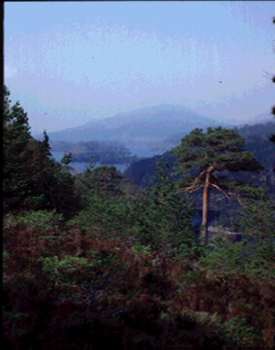
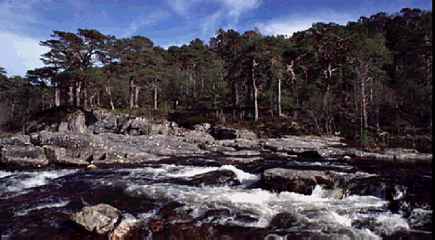
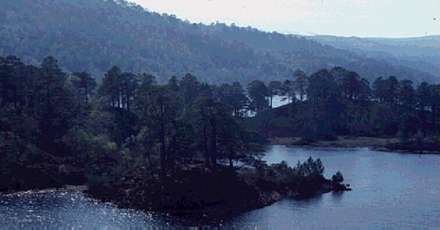
are a few places in Scotland were you can visit and see what the great forest
of Caledon must have looked like when it covered most of Scotland. I am very
lucky to live near one of them, Glen Affric in the Scottish Highlands. This
area of lochs hills and forest with good stands of old Caledonian Pine has
a special
feel
about it words cannot describe accurately. The single track road winding
round sharp corners and over small bridges lead you into a area of great
natural beauty with a new breathtaking panorama at every bend. The great
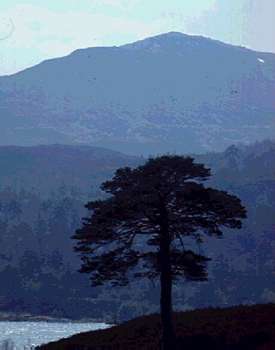
pines line the hillsides and the loch shores each one with its unique form
and character. The old pines can attain ages of 300 years plus! I personally
can vouch for this as I had the opportunity of counting the annular rings
on a cross section of a old tree. I gave up at 300 thinking well that's
old enough for me. Looking at the rings gives you a insight into the climatic
conditions of the past and it is interesting to note growth spurts and periods
of slow growth. Indicators to forest fire and tree damage show up clearly
and the healing process that followed.
The
old pines are now protected from commercial felling and a active protection
and regeneration program exists. This is in the main managed and run by
Forest Enterprise along with Tree's for Life and various other organizations.
Non native species to the area are being gradually removed and reintroduction
of native species such as Birch and Rowan along
with
saplings grown from seed collected from the pines will restock the area
to its former glory. Some of the old pines distort with age and it is these
tree's which are commonly referred to as granny pines, no disrespect meant!
There huge limbs curving and twisting out from the trunk are a sight to
be seen and remind us how clever nature is. Its funny but even to a woodworker
its these tree's that appeal most visually and not the clean un tapered
bole of a perfect specimen. The old pines lay down vast amounts of resin
within the heartwood once they pass a certain age and you can see on some
tree's resin oozing out of a scar or damaged area. This is the tree's natural
way of protecting the damage from insects and fungal attack, while the new
wood growth covers the scar. Foresters surveying ancient woodland have told
me about old caleys they have come across that showed were local people
used to hack into the heartwood to remove slivers of timber to use as fire
lighters, the high content of resin assured a quick start to the fire. The
beautiful rust color of the bark and the multi-layered
texture peeling away with new growth contrasts wonderfully with the long delicate green pine needles in the canopy, oh there just great! A real insight into Scottish history, and natures magnificence.
Come and see them for yourselves!
texture peeling away with new growth contrasts wonderfully with the long delicate green pine needles in the canopy, oh there just great! A real insight into Scottish history, and natures magnificence.
Come and see them for yourselves!
The
Timber of the Caledonian Pine.
The
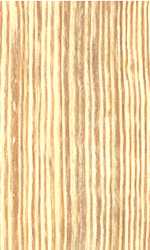
timber of the Caley pine looks exactly what it is, that is old and mature.
Heavy with resin and the scent of pine , this timber does not need stains
and distressing to look old it is. The nearest similarity would be to Honduras
Pitch Pine but Caley Pine has a unique character all of its own and should
be recognized as such.
Trying
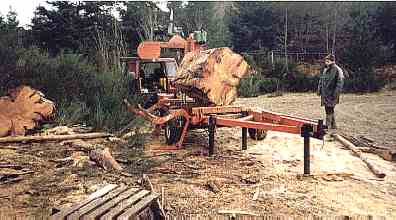
to mill a 4 foot diameter tree with a 2 foot saw, this pine
which was felled because of being a roadside danger proved
tricky to convert into boards. Note the heavily fluted end
section on the left. At 300 years + old this is to date
the oldest timber I have had the pleasure to
work.
which was felled because of being a roadside danger proved
tricky to convert into boards. Note the heavily fluted end
section on the left. At 300 years + old this is to date
the oldest timber I have had the pleasure to
work.
Further
information may be obtained from:-
Thanks
to:-
Forest Life Picture Library For there kind use of superb photos of Glen Affric.
*
George Macarthy (local forester)
*
Malcolm Weild (forest district manager)
*
Sandra Paul (local forest ranger)
*
Isabel Cameron (official forestry photographer)
*
for there help and enthusiasm and professional in-depth knowledge.
Forest Life Picture Library For there kind use of superb photos of Glen Affric.
*
George Macarthy (local forester)
*
Malcolm Weild (forest district manager)
*
Sandra Paul (local forest ranger)
*
Isabel Cameron (official forestry photographer)
*
for there help and enthusiasm and professional in-depth knowledge.